Sometimes the Problem Is in the Room.

Sometimes the Problem Is in the Room.

Why companies rarely fail because of strategy - but because of how teams decide, disagree, commit and take responsibility.

Most companies measure revenue, pipeline, forecast accuracy, productivity and customer satisfaction.
But they rarely measure the behavioural patterns that determine whether a team can actually execute.

The Team Alignment Assessment makes these patterns visible.

→ Download WhitePaper

Curious what the outcome looks like?

The White Paper explains the methodology.

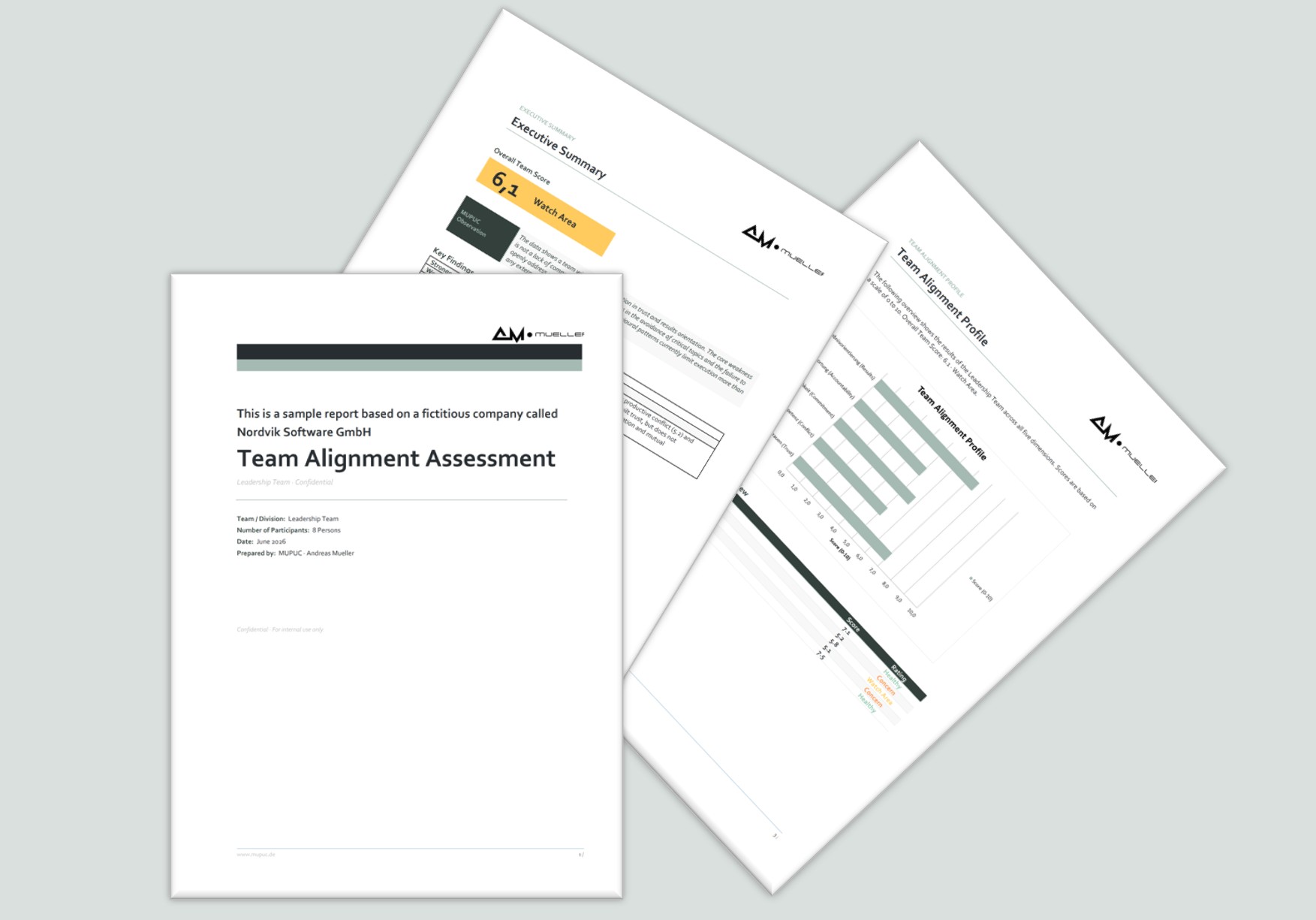
The sample report demonstrates how anonymous team responses are transformed into a structured management diagnosis.

Discover how anonymous team feedback is transformed into a professional executive report - highlighting strengths, behavioural risks and concrete recommendations for action.

↓ Prefer seeing the result before reading the theory?

9-Page Executive Assessment Report
Based on a fictitious software company with 8 leadership team members.

Included in the report
Executive Summary  -  Team Alignment Profile  -  Advisor Commentary  -   Recommended Actions

-

The Control Gap

The Control Gap

Why growth often hides the absence of control

A few months ago I sat in a management meeting reviewing a company having a great year.

Revenue up. Pipeline strong. Forecasts ambitious. Board happy.

Everything seemed under control.


Then someone asked a simple question: "Why are we confident we will hit these numbers?"

The answers came fast. Marketing pointed to lead generation. Sales pointed to pipeline growth. Management pointed to the forecast.

One result. Three different stories.

Some based on data. Some on experience. Some on little more than optimism disguised as logic.


That's the moment I pay attention. Because I've seen this pattern many times.

Everyone had an explanation. Nobody could demonstrate what was actually driving the growth.

Growth creates confidence. Confidence creates assumptions. Assumptions slowly replace evidence.


And for a while, nobody notices. As long as revenue keeps growing. As long as the market stays favorable. As long as forecasts are close enough. As long as nobody looks too closely. 

Then reality arrives.

Deal cycles get longer. Forecasts start missing. Acquisition costs rise. Key people leave. Growth slows.

And leadership teams discover something uncomfortable: they were measuring outcomes. Not control.


Two companies can report the same growth. The same EBITDA. The same pipeline. The same forecast. And still be completely different businesses.


One understands the mechanics behind its success. The other mistakes success for understanding.

The difference stays invisible - until conditions change.


So the most important question for a leadership team is not: "How fast are we growing?"

It's: "Could we explain why - if someone challenged every assumption in the room?"

Because sooner or later, every company finds out whether it was growing by design - or by accident.

If Darwin Worked in Sales

If Darwin Worked in Sales

Darwin's logic is brutally simple.

Variation. Selection. Adaptation.

Not the strongest survives. The best adapted.
That applies to species. To markets. And to every pipeline.

1. Variation: The Pipeline Is Not a Queue. It Is an Ecosystem.
Every sales opportunity is its own organism.
Different urgency at the customer. Different power dynamics in the account.
Different political dynamics. Different decision logic.

Stages, criteria, forecast logic — these must be standardized. That is architecture.
What must not be standardized: the strategy. The attention. The resources.

A deal at 30% is not a state — it is a situation. And every situation is different:
different competition, different political dynamic, different decision-maker, different time pressure.

Anyone who treats all deals at 30% the same is not managing.
They are running a monoculture. And monocultures collapse — not slowly, but suddenly.

Anyone who treats all deals the same does not lose oversight. They lose control.

2. Selection: The Environment Decides. Not the CRM.
In nature, it is not the organism that decides whether it survives. The environment decides. In sales, the environment is the customer.

Not the forecast. Not the pipeline review. Not the internally set close date. It is the customer.
And the customer's environment asks exactly three questions:

– Is there a real problem — or only interest?
– Is there someone with decision authority — or only with an opinion?
– Is there a real buying process — or only conversations?

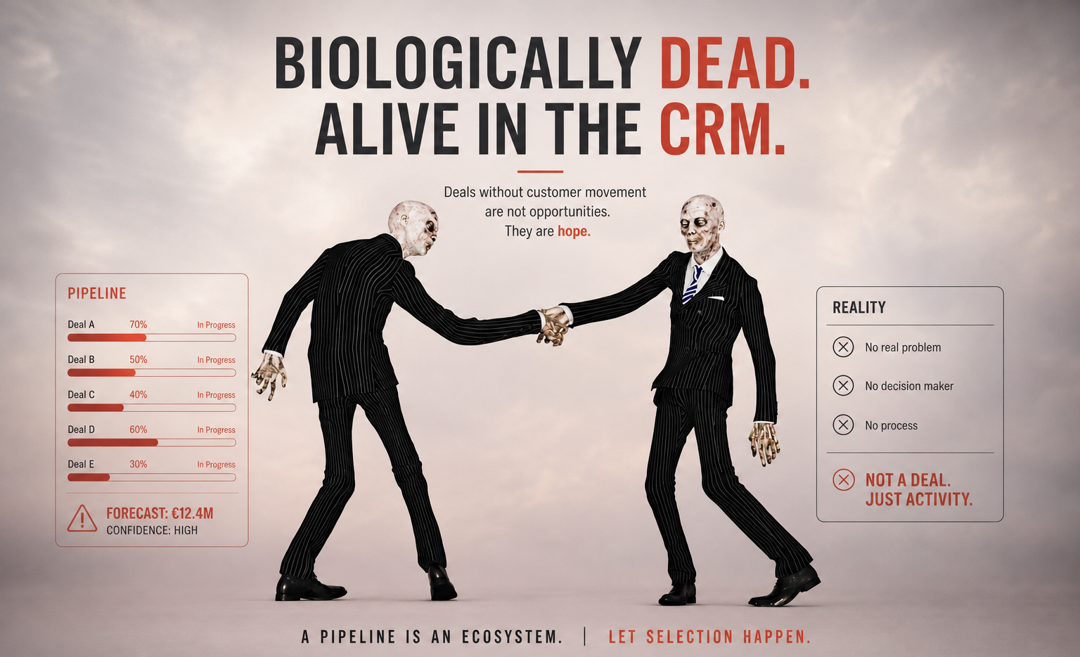
Anyone who cannot answer these questions does not have a deal. Only hope.

3. Extinction: What Actually Dies — and What Is Kept Artificially Alive.
This is the uncomfortable part.

In nature, most variants die. That is not a tragedy. That is function. Selection makes the system strong because it removes the weak. In most sales organizations, this does not happen.

Deals do not die. They are protected.

Close dates get pushed. Probabilities stay unchanged. Internal activity replaces customer-side progress. And no one asks the only question that matters:
What has actually changed at the customer — since the last conversation?

The result is a system that works against its own logic. Biologically dead. Alive in the CRM.
This is not a forecast problem. This is anti-Darwinism — actively practiced, daily, with the best of intentions.

4. Survival of the Fittest: The Best Product Does Not Win.
This is the fallacy almost every sales organization carries with it.
– The best product wins.
– The most compelling demo wins.
– The most complete feature list wins.

Darwin would disagree.

Not the strongest survives — the best adapted. In sales, the best product does not win. The deal that fits the customer wins. Everything else is product thinking.

5. What Darwin Actually Demands.
Selection is being prevented. And that is exactly the problem.

The consequence is simple: selection must be allowed. Not theoretically. Not next quarter.
Now.

Opportunities without customer-side movement die. No resuscitation through internal activity. No pushed close dates as a substitute for missing clarity.

Organizations must stop protecting their own system. Forecasts that do not force decisions. Pipeline reviews that generate comfort instead of clarity. CRM fields that encode hope instead of reflecting reality. All of this is the same pattern: the ecosystem gets distorted. Weak opportunities get protected. And everyone wonders why growth is not happening.

6. The Real Question.
Most organizations ask: How do we get more opportunities into the pipeline?
The wrong question.

Darwin asks: Which opportunities have the right to survive — and which are only being kept alive because dying is uncomfortable?

Growth does not come from more variation. It comes from better selection.

Sales does not fail because of too few opportunities. It fails because of too little selection.
Everything else is hope. Just better worded.


Back ------


Business Reality Review & The Forecast Illusion

Business Reality Review
The Forecast Illusion – and How to Break It

Companies love numbers.
They love dashboards, forecasts, probabilities, funnels, pipelines, and reports.
And yet they keep failing at the exact same point:

The numbers look plausible – but reality does something else.

The Business Reality Review is not another tool, not a new meeting, and not a methodological upgrade.

It is a leadership and steering system that asks an uncomfortable question:
Is your revenue planning based on real causality – or on hope, activity, and well-told stories?

Anyone who answers that question honestly realizes very quickly:
Most forecasts are not steering instruments.
They are sedatives.

What this system deliberately is not

The Business Reality Review is not a sales meeting where deals are retold.
It is not a forecast ritual designed to produce numbers that simulate certainty.
It is not a coaching format, not a feedback circle, and not a space for opinions.

It is a steering instrument.
And if nothing is decided, changed, or stopped after the meeting, it was not a Business Reality Review – it was a waste of time.

The real problem nobody wants to name

In most organizations, there are more numbers than clarity:

  • Revenue targets.
  • Forecasts.
  • Pipelines.
  • Probabilities.
  • CRM reports.

And yet the same things keep happening:

  • Forecasts regularly miss the mark.
  • Meetings revolve around individual cases.
  • Activity is confused with progress.
  • Numbers calm people down – but they do not lead.

The core mistake is surprisingly simple and deeply structural:

  • Numbers are reported, but not interpreted.
  • And certainly not placed into a causal context.
  • The Business Reality Review starts exactly here – and cuts away everything else.

The simple, hard core idea

Revenue only happens when two conditions are fulfilled at the same time.

First:
There is enough potential volume.

Second:
The organization is capable of actually closing that volume.

Not by gut feel.
Not by storytelling.
Not by explanation.
But measurably.

These two realities are strictly separated in the Business Reality Review.
Not blended, not softened, not interpreted as “holistic.”

There are exactly two metrics:

  • Volume Indicator.
  • Execution Indicator.

Everything else is noise.

Volume Indicator – the brutal volume question

The Volume Indicator answers one single question:
Is there enough pipeline at all to reach the revenue target?

It does not measure how well selling is done.
It does not measure competence, engagement, or effort.

It measures only one thing:
Is the sheer amount of opportunity sufficient – yes or no?

A strong Volume Indicator is not success.
It is merely the absence of a structural deficiency.

If this number is weak, you do not have a sales problem.
You have a go-to-market problem.

Execution Indicator – the uncomfortable truth

The Execution Indicator asks the question most organizations avoid:
How realistic is it that this pipeline will actually turn into revenue?

It does not measure activity.
It does not measure conversation quality.
It does not measure hope.

It measures closing capability.

Every opportunity has a value and a probability.
The Execution Indicator is based on the weighted forecast – and therefore on the honesty of those probabilities.

Weak execution does not mean people do not work hard.

It means deals are qualified poorly, decisions come too late, or selling becomes political.

Why only both indicators together create reality

The real value of the system does not sit in the individual metrics, but in their combination.

High Volume Indicator, low Execution Indicator:
Many opportunities, low closing probability.
A lot of work, little impact.
Typical for weak qualification, early-stage deals, and missing decision power on the customer side.

Low Volume Indicator, high Execution Indicator:
Good deals, clean closes – but too little pipeline.
Not a sales problem, but an acquisition, positioning, or capacity problem.

Both indicators weak:
Not an operational issue.
A leadership and go-to-market failure.

Both indicators strong:
Sufficient volume.
Realistic execution.
That is not luck – that is steering.

What actually happens in the Business Reality Review

The system runs weekly or monthly.
No drama. No show. No deal theater.

Each accountable owner simply reports:
On Track or Not On Track – based on volume and execution.

If something is Not On Track, an issue is named.
Not discussed. Not explained. Named.

All issues are collected, prioritized, and solved one by one.
Decisions lead to clear actions.

Individual deals matter only if they reveal a structural problem.
Not because they sound exciting.

The real benefit

The Business Reality Review does not improve numbers.
It makes them more honest.

And honest numbers are the prerequisite for leadership.

For decisions.
For focus.
For accountability.
For fewer surprises.
For fewer political forecasts.

Or put differently:
This system does not tell you how to sell.
It shows you where your reality does not match your story.

That is exactly why it works!

Back ------


Why Hope Is Not a Strategy

Introduction
Many discussions about go-to-market, forecasts, methodologies, or sales playbooks revolve around symptoms.
Numbers, processes, tools, models.

This article goes one level deeper. It describes the underlying fallacy that connects all of these topics: the confusion of hope with steering logic.

Not as an opinion piece.
But as a structural framing.

Anyone who understands go-to-market as a leadership responsibility – rather than a communication or sales topic – will find the common denominator here.

On Go-to-Market, Numbers, and the Most Dangerous Fallacy of Modern Leadership

Hope is not a soft topic.
It is not an emotional side issue.

Hope is one of the most powerful – and dangerous – forces in leadership.

Not because it is irrational.
But because it disguises itself so convincingly as rationality.

The Modern Fallacy: When Hope Appears as a Number

Few things look more objective than a number.
Few things convey more control.

Percentages. Probabilities. Forecasts. Pipeline coverage.
All neatly quantified. All seemingly logical.

And that is exactly where the problem begins.

Many of these numbers do not measure reality.
They encode hope.

  • “80 percent close probability”
  • “Q2 is on track”
  • “The pipeline looks good”
  • “That should be enough”

The math is correct.
The foundation is not.

Go-to-Market Is Not a Communication Problem – It Is a Steering Problem

Go-to-market is often discussed as:

  • a sales topic
  • a marketing question
  • an organizational model
  • a tool or process issue

In reality, go-to-market is something else:

A system that translates intent into results.

Systems do not follow hope.
They follow logic.

A functioning go-to-market approach does not answer motivational questions.
It answers steering questions:

  • Which activities demonstrably create progress?
  • Where does movement turn into substance?
  • At what point does reality change – not just perception?
  • When does probability increase measurably, not emotionally?

Without these answers, go-to-market remains a narrative model.

The Central Fallacy: Probability Without an Event

The greatest error in modern steering is banal – and fatal:

Probability is assigned before anything has actually happened.

A conversation – probability goes up.
A workshop – probability goes up.
A positive feeling – probability goes up.

But none of this is an event.

An event is something that:

  • cannot be reversed
  • creates consequences
  • incurs cost
  • changes behavior

Without an event, there is no reliable probability.
Only hope with a percentage sign.

Hope Replaces Causality

In many organizations, numbers are used to cover uncertainty – not to understand it.

They calculate:

  • pipeline x probability
  • coverage x target
  • activity x optimism

What is missing is causality.

Not: How do we feel?

But: What has happened that actually changed reality?
What is the concrete plan?
And what must necessarily happen for this number to become true?

Without explicit causality, every number becomes a sedative.

Why Methodologies Do Not Solve the Problem

When faced with uncertainty, organizations reflexively turn to methodology:

  • new phase models
  • new qualification criteria
  • new scoring systems
  • new tools

The problem is not the methodology.
The problem is its function.

As long as methodologies are used to structure hope instead of destroying it,
they remain part of the problem.

Any methodology without hard stop criteria
is a hope system.

Leadership Begins Where Hope Is Withdrawn

That sounds harsh.
But it is central.

Leadership does not mean creating hope.

It means eliminating hope as a basis for decision-making.

Not through cynicism.
Not through pessimism.

But through clarity.

Clarity about:

  • what we know
  • what we do not know
  • what we merely assume
  • and what we are conveniently calculating in our favor

Only then does real steering capability emerge.


Go-to-Market Requires Math – Not Magic

A mature go-to-market approach is not based on:

  • motivation
  • narratives
  • best practices
  • experience alone

But on:

  • clear events
  • traceable causality
  • explicit handover points
  • robust assumptions

Everything else is hope – disguised as a number.

The Uncomfortable Truth

Hope is human.
Hope is understandable.
Hope is sometimes necessary.

But hope is not a strategy.

And reality is not created by intent,
but by causality, discipline, and repeatability.

Strategy begins where organizations have the courage to:

  • let go of comforting numbers
  • make uncertainty visible
  • tie decisions to events
  • stop confusing leadership with optimism

Because growth does not happen when hope works out.

It happens when systems are built to function
even without hope.

Why Causality Is Decisive in Leadership, Sales, and Go-to-Market

Causality matters because it answers three questions:

  1. What actually happened?
  2. Why did it happen?
  3. What must we change so it happens differently next time?

Without causality, only hope remains.
With causality, organizations gain the ability to act.


The Problem Is Not That Forecasts Are Wrong

The Problem Is Not That Forecasts Are Wrong – but That They Are Built Wrong

Forecasts are necessary. 
Companies have to make decisions about the future.
Investments, capacity, priorities, risk. None of this works without looking ahead.

So the problem is not that forecasts exist.
The problem is what they are based on.

Forecasts Do Not Fail Because of Math – but Because of Logic

Most forecasts are formally correct.

The calculations are right.
The models are clean.
The numbers are consistent.

And yet they lead to wrong decisions – or worse: to no decisions at all.

Why?

Because they try to calculate uncertainty before reality has actually changed.

Probability Without an Event Is Not Steering

The core mistake of modern forecasting is simple – and fatal:

Probability is assigned without a meaningful event having taken place.

A good conversation increases the probability.
A workshop increases the probability.
A positive feeling increases the probability.
A full calendar increases the probability.

But none of that changes reality.

An event is something else:

  • A decision has been made
  • A budget has been released
  • A risk has been explicitly accepted
  • A commitment is binding

Without such events, every probability is just an assumption.

And assumptions are not a foundation for decisions.

The Real Damage: Forecasts Create False Certainty

A wrong forecast is not dangerous because it is inaccurate.
It is dangerous because it is plausible.

It creates the feeling:

“We know enough to wait a little longer.”

And that is where the problem begins.

Instead of deciding, organizations observe.
Instead of clarifying, they refine.
Instead of drawing consequences, they re-evaluate.

Not out of convenience.
But out of perceived rationality.

Bad Forecasts Do Not Cause Wrong Decisions – They Cause Decision Avoidance

This is the real point.

A bad forecast rarely leads to an actively wrong decision.
It leads to no decision at all, because the numbers are “not clear enough yet”.

  • One more update
  • One more review
  • One more month

The forecast provides the perfect justification.

Not because people do not want to lead.
But because no one wants to lead on a flawed foundation.

Forecasts Fail When They Quantify Feelings Instead of Reality

Many forecasts do not measure what has happened.
They measure how confident people feel.

That is human.
But it is not a steering model.

A robust forecast is not based on:

  • opinions
  • moods
  • optimism
  • experience alone

It is based on clear transitions:

  • What has objectively changed?
  • What is no longer reversible?
  • Where has possibility turned into obligation?

Without that logic, every number becomes a delay tactic – unintentionally.

The Uncomfortable Truth

Forecasts are necessary.
But they are only as good as the events they are tied to.

If forecasts do not enable decisions,
the problem is not a lack of courage –
it is a lack of causality.

Organizations do not wait because they hesitate.
They wait because they sense that the numbers do not force anything.

A good forecast does not answer:

“How safe does this feel?”

It answers:

“What has happened – what follows from it – and what still needs to happen?”

Everything else is not a forecast.

It is hope with a calculation.

Why Good Questions Create More Revenue Than Good Forecasts

Companies invest enormous effort in forecasts.

Models. Probabilities. Scenarios. Updates.

And surprisingly little effort in what actually creates revenue:
the right questions at the right time.

The result is predictable:

Many numbers.
A lot of activity.
Very little clarity.


Forecasts Describe – Questions Change

A forecast describes a state.
A question changes it.

Forecasts say:

  • “This is where we are.”
  • “This is how likely it is.”
  • “This is how we could plan.”

Good questions say:

  • “Why is no one deciding?”
  • “What is actually missing?”
  • “What happens if we do nothing?”
  • “Who carries the risk – and why?”

The difference is fundamental.

Forecasts observe reality.
Questions force reality.

Revenue Is Created by Clarification, Not Estimation

No customer buys because a forecast looks good.
No deal closes because a probability increases.

Deals close when:

  • a decision is made
  • a risk is accepted
  • a problem can no longer be postponed
  • someone takes responsibility

None of that happens through calculation.

It happens through confrontation – with the right questions.

Forecasts Reward Smoothness – Questions Create Friction

Forecasts love clean pictures:

  • upward curves
  • round percentages
  • consistent storylines

Good questions destroy that.

They surface:

  • ambiguity
  • contradictions
  • missing decision-makers
  • unspoken doubts

And that is exactly why they are asked so rarely.

Not because they are impolite.
But because they have consequences.

Bad Questions Feed Forecasts – Good Questions Make Them Obsolete

Most forecasts exist because the wrong questions were asked earlier.

For example:

“How likely is the deal?”
instead of
“What would have to happen for it to become real at all?”

Or:

“When could the deal close?”
instead of
“What is preventing it – today?”

Forecasts compensate for missing clarity.
Good questions create it.

Good Questions Are Uncomfortable – and That Is Why They Work

A good question rarely feels good.

It:

  • slows down conversations
  • interrupts routines
  • forces positioning
  • exposes excuses

Examples of revenue-relevant questions:

  • “Who really decides – and who just pretends to?”
  • “What happens if you decide against us?”
  • “Which internal risk are you trying to avoid right now?”
  • “Why is this important now – and not three months ago?”

These questions do not increase close probability.

They change the reality in which a close becomes possible.

Forecasts React – Good Questions Lead

Forecasts are reactive.
They respond to what has already happened – or what feels like it has.

Good questions are active.
They determine what happens next.

That is why good questions create:

  • shorter sales cycles
  • clearer decisions
  • cleaner exits
  • more reliable revenue

Not because they are clever.

But because they bring leadership into the conversation.

The Uncomfortable Truth

Companies with many forecast meetings often have poor conversations.
Companies with good questions need fewer meetings.

Not because they abandon planning.

But because they know earlier:

  • where reality begins
  • where hope ends
  • where a “no” is more valuable than a “maybe”

Revenue is not created by better numbers.
It is created by better questions.

Everything else is statistics.

And statistics do not sell.


de_DE