
Almost 20 years ago, my former boss Peter Schroer, founder of Aras, had a simple rule.
Whenever there was a serious customer problem, he would say:
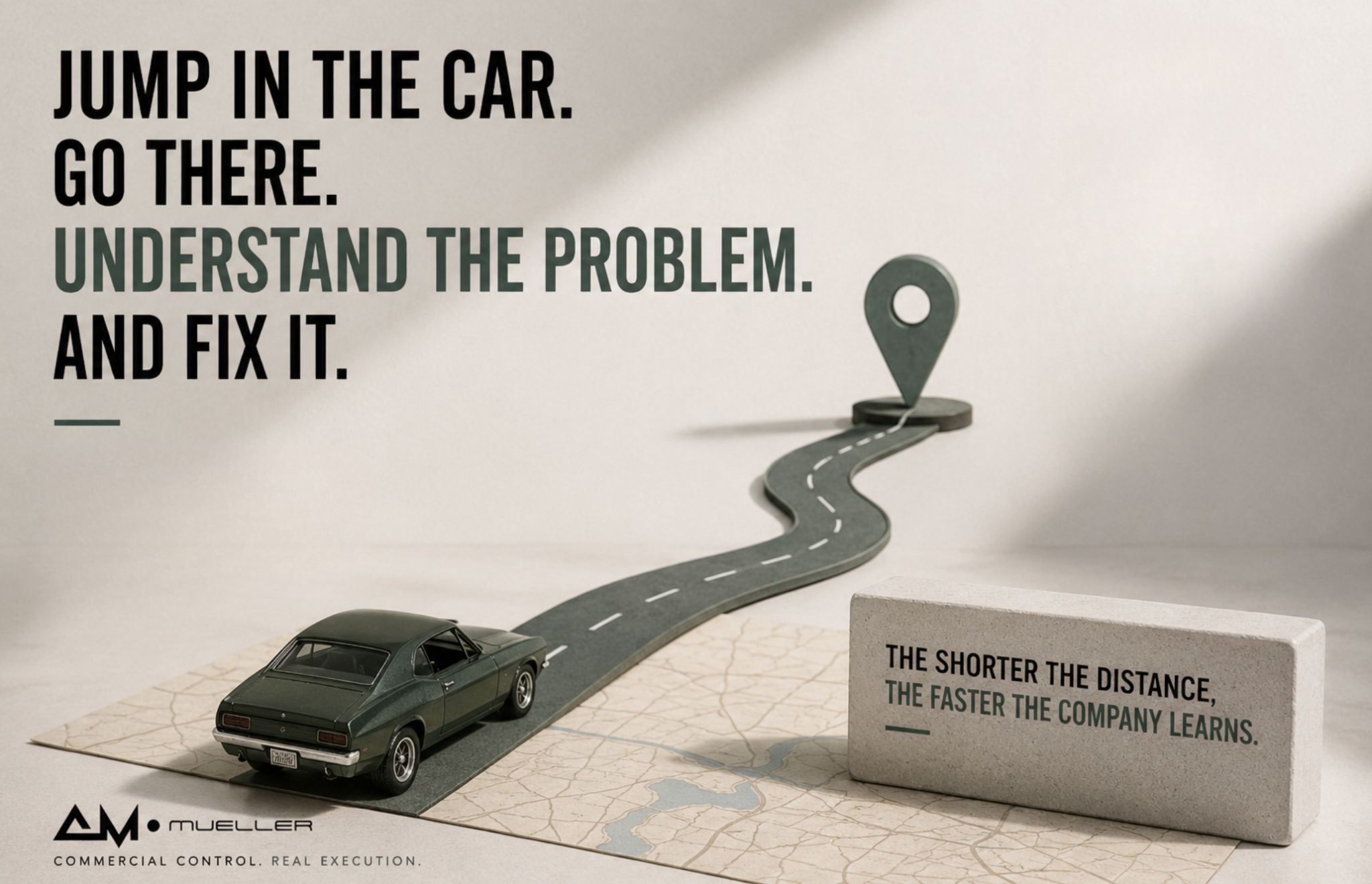
“Jump in the car. Go there. Understand the problem. And fix it.”
Not exactly a sophisticated management framework. But remarkably effective.
The sentence stuck.
Because of the idea behind it:
Keep the distance between a customer problem and the people who can fix it as short as possible.
When customer signals have to travel
Aras has preserved much of that principle - and speed - to this day.
Many companies struggle to do the same as they grow.
They get bigger. More professional. More specialized.
And suddenly, a customer signal has to travel:
Support → Customer Success → Sales → Product → Prioritization → Engineering → Release → Customer.
Everyone is doing their job.
And yet the company has become slower.
A system that learns within days
I thought about Peter’s rule again while looking at an unusual innovation system:
Ukraine.
In 2022, Ukraine had around 7 drone companies.
By 2025: more than 500.
Brave1 now works with 2,100+ developers and 5,000 products. Over 500,000 drones had been ordered by mid-2026.
All this is happening under the horrific conditions of war.
But the speed at which this system learns is remarkable.
Something doesn’t work. Something else works better.
Users choose. Demand shifts. Capital shifts. Manufacturers respond.
A better version goes back into the field. The loop starts again.
Not every year. Not every quarter. Sometimes within days.
Ukraine even applies an interesting capital rule:
- 80% to proven solutions.
- 20% to new developments and testing.
This isn’t simply speed.
It’s an architecture in which reality changes decisions quickly.
The metric that is missing
We measure Release Frequency. Time to Market. Sales Cycle. Pipeline Velocity.
But one metric is missing:
How long does it take for a customer signal to change what the company does?
Not until it reaches the CRM.
Not until the next product meeting.
Until a different decision is made.
Three days? Three months? Three quarters?
A software company can release every two weeks and still be slow.
If customer reality takes six months to change a commercial or product decision, the cycle that matters isn’t two weeks.
It’s six months.
Go-to-Market is a two-way street
We see Go-to-Market too much as a one-way street:
Company → Market
Marketing. Sales. Channels. Pricing. Adoption.
But it needs the opposite direction too:
Market → Company
What works? What doesn’t? What gets used? What gets bought?
What changes a decision?
That’s where innovation, Go-to-Market and Commercial Control come together.
Not in the dashboard.
In the loop.
Keep the loop short
Peter had a pragmatic way of keeping that loop short:
“Jump in the car. Go there. Understand the problem. And fix it.”
Thanks, Peter. That lesson stuck.
Today, we have CRM, Product Analytics, Customer Success Platforms, AI - and more customer data than ever.
Has all this really brought us closer to reality - or have we just built better systems for reality to travel through?

