Why Success Becomes Normal So Quickly

Why Success Becomes Normal So Quickly

Why Success Becomes Normal So Quickly

And why companies need a future people can look forward to

A man looking across an illuminated path towards a guiding star on the horizon

I’ve come to believe: we don’t just want to reach many things.

We want to be on the way to them.

We look forward to a trip for months. We plan a house, a new car, a professional
challenge, or a big project. We explore possibilities, make decisions, and imagine
what it will feel like once everything is done.

Then the moment arrives.

The house is move-in ready. The car is in the driveway. The contract is signed.
The project is finished.

For a moment, it feels great.

And shortly after, it’s normal.

Not bad. Not worthless. Just no longer extraordinary.


The special thing doesn’t necessarily lose its value. It loses its tension.

Anticipation Lives on Possibility

Maybe that’s why anticipation is often the greatest joy.

As long as something still lies ahead of us, it isn’t fully fixed. In our imagination
there’s no routine, no maintenance, no compromises, and no small disappointments.

The future lies open before us.

We don’t just enjoy the expected outcome. We enjoy every possibility we attach to it.

The finished result can hardly compete with that idea. It’s concrete. It has edges.
And above all, it becomes part of our everyday life very quickly.

Psychology calls this hedonic adaptation: people adapt astonishingly fast to
improvements.


What was a big wish yesterday is reality today and normal tomorrow.

Goals Give Us Direction, Not Lasting Happiness

We like to tell ourselves:

Once I reach this goal, I’ll be satisfied.
Once the project is finished, things will calm down.
Once I reach this position, this house, or this financial security, I’ll have arrived.

But we never really arrive.

An achieved goal usually changes our state only temporarily. It creates a moment
of joy, pride, or relief. Then the adjustment begins.

That doesn’t mean goals are pointless.

Quite the opposite.

Without goals we lack direction. Without challenges we lack development. And without
something to look forward to, life quickly turns into managing what’s already been
achieved.

Goals focus energy. They put us in motion. They force us to decide and give our
actions direction.

They’re just not built for lasting satisfaction.

Even a Successful Ending Is a Loss

When a big project ends, it’s not only a problem that disappears.

A task disappears too.

Suddenly the open questions are gone, the decisions, the progress, and sometimes
even the conflicts that occupied us for months.

We won. But the playing field is gone.

Maybe that’s why an unexpected emptiness sometimes follows big successes.

Not because the success was worthless. But because the path there gave our life more
structure, tension, and meaning than the finished result did.

“Done” is therefore a strange state.
It’s success and loss at the same time.

The Same Thing Happens in Companies

Companies set goals.

A certain revenue target has to be hit. A product has to ship. A funding round has
to close, a new market has to open, or a company has to be sold successfully.

People work toward it for months or years.

Then the goal is reached.

There’s a presentation, a bonus, maybe a celebration. The numbers get shown.
The success gets praised.

And the next Monday, the new quarter begins.

The extraordinary result becomes the new baseline. The record becomes the new minimum.
Success becomes expectation.

What was celebrated yesterday is part of today’s budget.

Companies get used to success too.


When all that follows is a higher revenue target, no new meaning is created.
Only more pressure is.

A Goal Is Not Yet a Vision

“We want to grow 20 percent next year” is not a vision.

It’s a goal.

“We want to become market leader” usually isn’t a vision either. It describes a
position, not yet a future that makes a recognizable difference for customers,
employees, or society.

A real vision answers a bigger question:


What future do we want to create that wouldn’t exist without us?

It has to be ambitious. Bigger than what feels comfortably achievable with today’s
structures.

Maybe even so big that it initially seems almost unreachable.

But it has to stay credible.

People need to be able to see that this future is possible and that their work
contributes to making it real.

A good vision isn’t fantasy.

It’s a plausible possibility, big enough to move people.

The North Star Prevents Managing What’s Already Been Achieved

The vision describes the future a company wants to create.

The North Star keeps the direction stable.

Strategic goals mark the next milestones.

Operational measures make sure the company actually moves.

The North Star doesn’t have to be reached every year. Its job is different. It shows
whether the company is still heading the right way.

That creates something many companies lack: shared anticipation.

Not the shallow enthusiasm of a motivational event. But the well-founded expectation
of working together on something meaningful.

What’s true for people is true for companies too:


Without a picture of the future, success quickly turns into managing what’s
already been achieved.

Vision Alone Isn’t Enough, Though

A big sentence on the wall doesn’t sustain a feeling of joy, belonging, or recognition.

For that, people need to experience in everyday life that something is moving.

They need to understand:

  • Where do we want to go?
  • Why does it matter?
  • What do I contribute to it?
  • How do we recognize progress?
  • Which milestones have we already reached?

A vision creates meaning.

Visible progress creates motivation.

Recognition creates belonging.

Milestones celebrated together create energy for the next stretch.

Companies therefore can’t just look at the final result. They also have to make
the path there visible.

Because if progress only becomes visible at year-end, motivation stays a matter
of faith for months.

People Don’t Need Permanently More

The answer can’t be to simply announce the next, even bigger goal after every success.

More revenue. More growth. More efficiency. More market share.

At some point, ambition turns into an endless loop.

People don’t need permanently more.

But they need development.

They want to experience that their work makes a difference, that they’re learning,
that they’re overcoming obstacles together, and getting closer to a meaningful future.

The difference matters.

Whoever keeps demanding more creates exhaustion.
Whoever enables development creates momentum.

Vision Without Execution Stays Hope

A vision can inspire people. But it can’t replace poor leadership, unclear decisions,
or conflicting priorities.

If nobody knows which customers really matter, what counts as a qualified opportunity,
or who’s accountable for critical decisions, even the most beautiful North Star
won’t help.

Then the vision stays hope.

So a company needs both:

A future big enough to move people.

And an operating system that enables daily progress in that direction.

Vision without execution stays a poster.


Execution without vision becomes a machine that runs faster and faster,
without knowing where to.

Maybe Success Isn’t a State, But a Rhythm

Anticipation is often the greatest joy.

But it’s not the only one.

There’s the joy of development. The joy of shared progress. The pride in a milestone
reached. The recognition for a contribution made. And eventually, curiosity about
what comes next.

None of these phases lasts forever.

Maybe it doesn’t have to.

A good life and a good company may not consist of finally arriving somewhere.

They live on a reasonable rhythm of imagination, effort, progress, success,
recognition, and new orientation.

A company needs more than goals, therefore.

It needs a future people can look forward to.
How Far Does Reality Have to Travel?

How Far Does Reality Have to Travel?

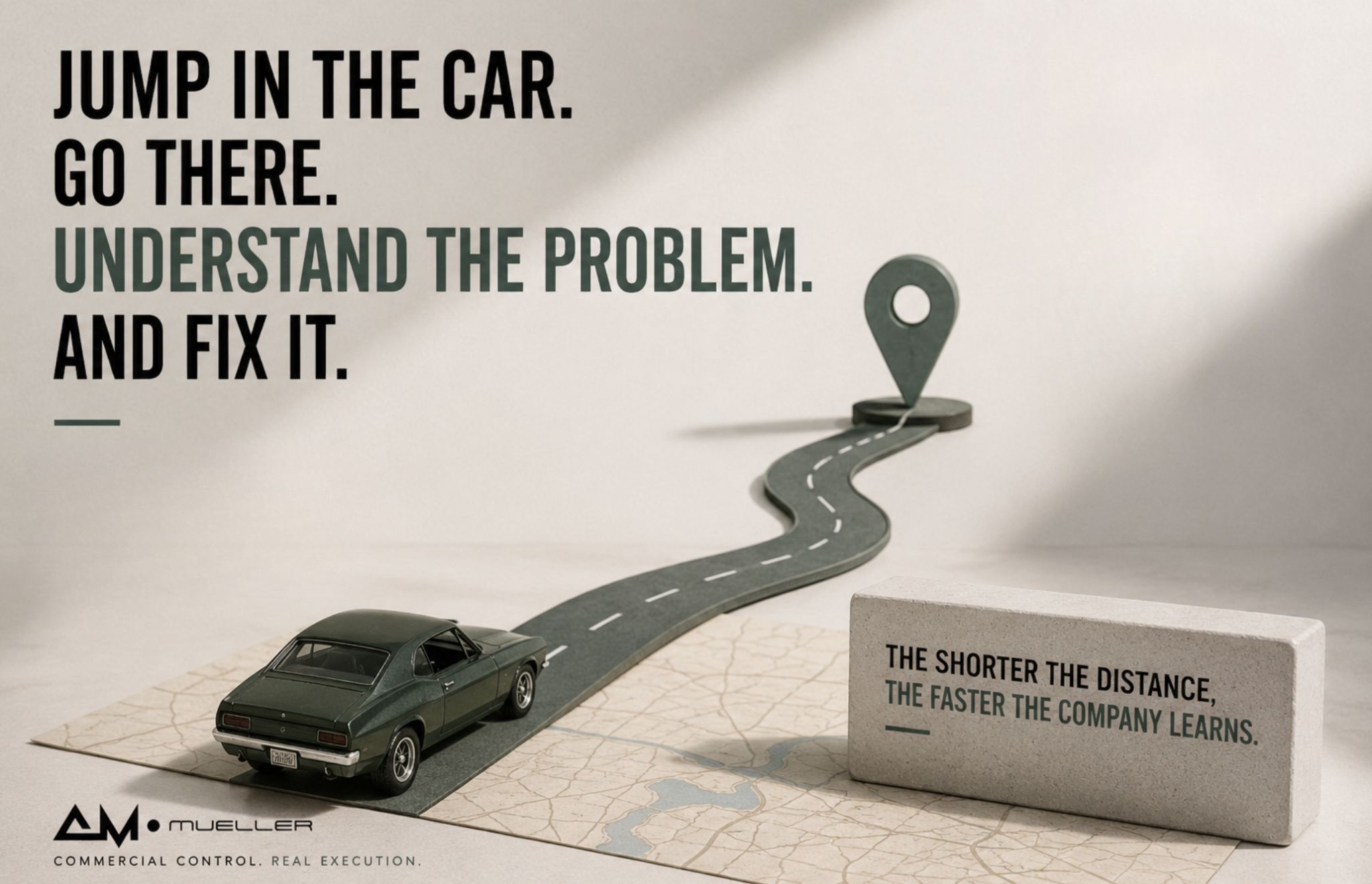
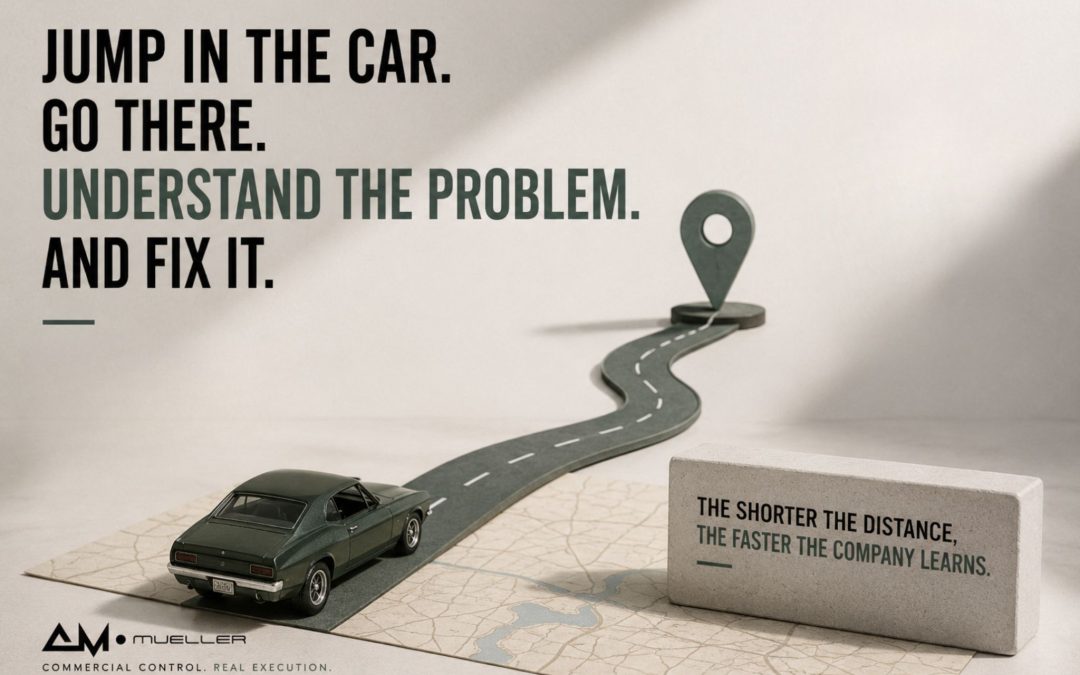
A road leading from a car to a destination, illustrating the distance between a customer problem and the people who can solve it

Almost 20 years ago, my former boss Peter Schroer, founder of Aras, had a simple rule.

Whenever there was a serious customer problem, he would say:

“Jump in the car. Go there. Understand the problem. And fix it.”

Not exactly a sophisticated management framework. But remarkably effective.

The sentence stuck.

Because of the idea behind it:

Keep the distance between a customer problem and the people who can fix it as short as possible.

When customer signals have to travel

Aras has preserved much of that principle - and speed - to this day.

Many companies struggle to do the same as they grow.

They get bigger. More professional. More specialized.

And suddenly, a customer signal has to travel:

Support → Customer Success → Sales → Product → Prioritization → Engineering → Release → Customer.

Everyone is doing their job.

And yet the company has become slower.

A system that learns within days

I thought about Peter’s rule again while looking at an unusual innovation system:

Ukraine.

In 2022, Ukraine had around 7 drone companies.

By 2025: more than 500.

Brave1 now works with 2,100+ developers and 5,000 products. Over 500,000 drones had been ordered by mid-2026.

All this is happening under the horrific conditions of war.

But the speed at which this system learns is remarkable.

Something doesn’t work. Something else works better.

Users choose. Demand shifts. Capital shifts. Manufacturers respond.

A better version goes back into the field. The loop starts again.

Not every year. Not every quarter. Sometimes within days.

Ukraine even applies an interesting capital rule:

This isn’t simply speed.

It’s an architecture in which reality changes decisions quickly.

The metric that is missing

We measure Release Frequency. Time to Market. Sales Cycle. Pipeline Velocity.

But one metric is missing:

How long does it take for a customer signal to change what the company does?

Not until it reaches the CRM.

Not until the next product meeting.

Until a different decision is made.

Three days? Three months? Three quarters?

A software company can release every two weeks and still be slow.

If customer reality takes six months to change a commercial or product decision, the cycle that matters isn’t two weeks.

It’s six months.

Go-to-Market is a two-way street

We see Go-to-Market too much as a one-way street:

Company → Market

Marketing. Sales. Channels. Pricing. Adoption.

But it needs the opposite direction too:

Market → Company

What works? What doesn’t? What gets used? What gets bought?

What changes a decision?

That’s where innovation, Go-to-Market and Commercial Control come together.

Not in the dashboard.

In the loop.

Keep the loop short

Peter had a pragmatic way of keeping that loop short:

“Jump in the car. Go there. Understand the problem. And fix it.”

Thanks, Peter. That lesson stuck.

Today, we have CRM, Product Analytics, Customer Success Platforms, AI - and more customer data than ever.

Has all this really brought us closer to reality - or have we just built better systems for reality to travel through?

Sometimes the Problem Is in the Room.

Sometimes the Problem Is in the Room.

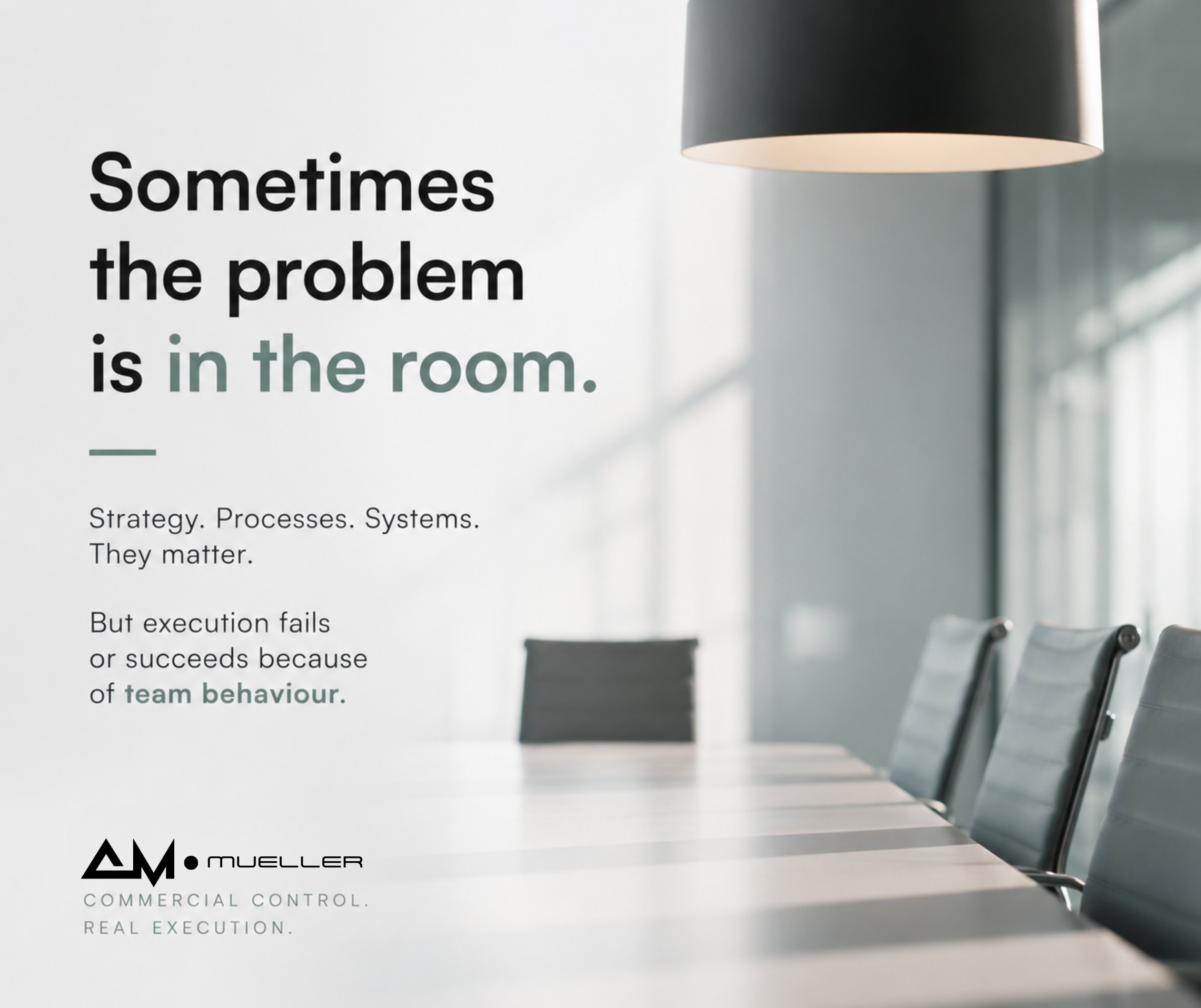
Why companies rarely fail because of strategy - but because of how teams decide, disagree, commit and take responsibility.

Most companies measure revenue, pipeline, forecast accuracy, productivity and customer satisfaction.
But they rarely measure the behavioural patterns that determine whether a team can actually execute.

The Team Alignment Assessment makes these patterns visible.

→ Download WhitePaper

Curious what the outcome looks like?

The White Paper explains the methodology.

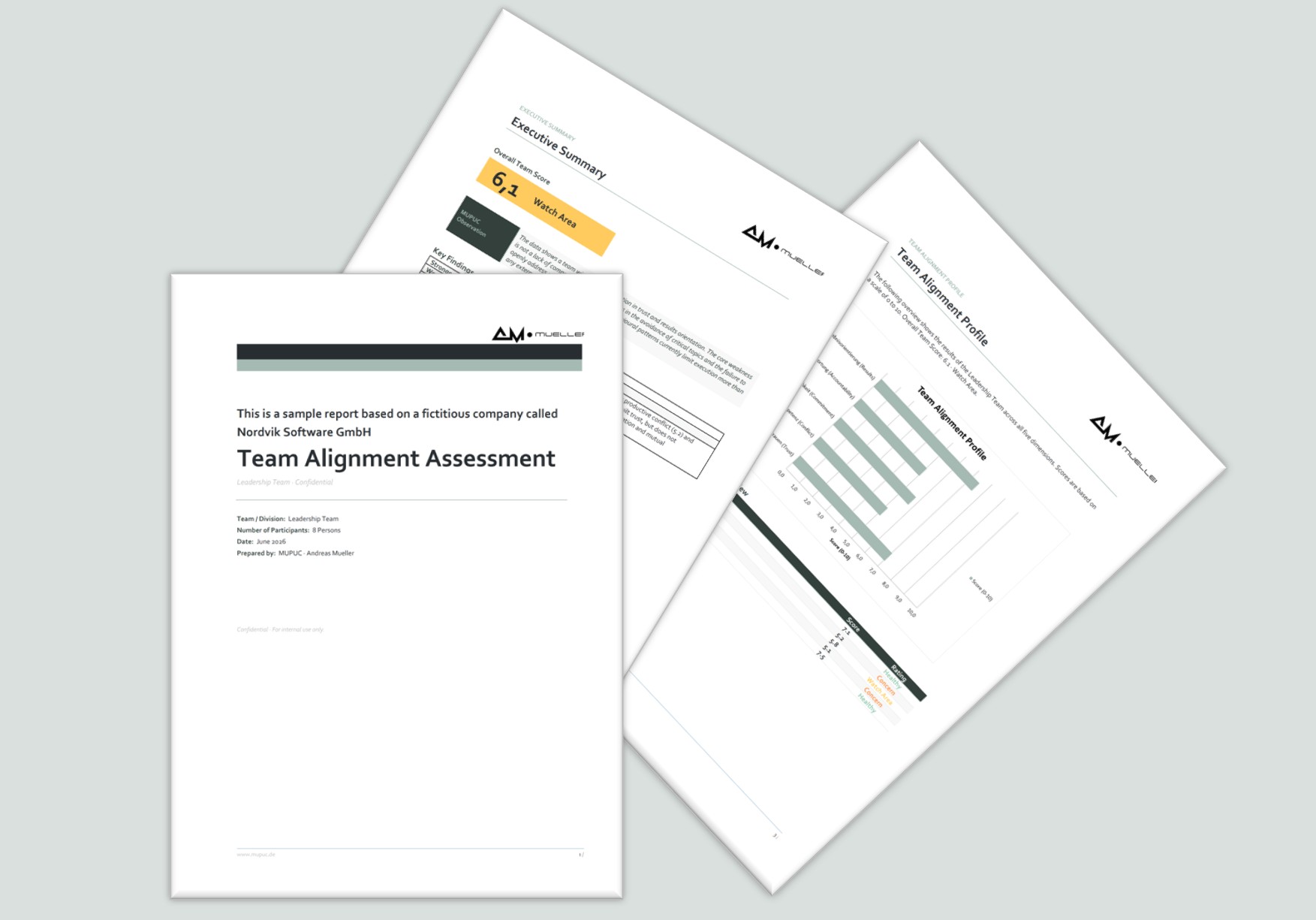
The sample report demonstrates how anonymous team responses are transformed into a structured management diagnosis.

Discover how anonymous team feedback is transformed into a professional executive report - highlighting strengths, behavioural risks and concrete recommendations for action.

↓ Prefer seeing the result before reading the theory?

9-Page Executive Assessment Report
Based on a fictitious software company with 8 leadership team members.

Included in the report
Executive Summary  -  Team Alignment Profile  -  Advisor Commentary  -   Recommended Actions

-

The Control Gap

The Control Gap

Why growth often hides the absence of control

A few months ago I sat in a management meeting reviewing a company having a great year.

Revenue up. Pipeline strong. Forecasts ambitious. Board happy.

Everything seemed under control.


Then someone asked a simple question: "Why are we confident we will hit these numbers?"

The answers came fast. Marketing pointed to lead generation. Sales pointed to pipeline growth. Management pointed to the forecast.

One result. Three different stories.

Some based on data. Some on experience. Some on little more than optimism disguised as logic.


That's the moment I pay attention. Because I've seen this pattern many times.

Everyone had an explanation. Nobody could demonstrate what was actually driving the growth.

Growth creates confidence. Confidence creates assumptions. Assumptions slowly replace evidence.


And for a while, nobody notices. As long as revenue keeps growing. As long as the market stays favorable. As long as forecasts are close enough. As long as nobody looks too closely. 

Then reality arrives.

Deal cycles get longer. Forecasts start missing. Acquisition costs rise. Key people leave. Growth slows.

And leadership teams discover something uncomfortable: they were measuring outcomes. Not control.


Two companies can report the same growth. The same EBITDA. The same pipeline. The same forecast. And still be completely different businesses.


One understands the mechanics behind its success. The other mistakes success for understanding.

The difference stays invisible - until conditions change.


So the most important question for a leadership team is not: "How fast are we growing?"

It's: "Could we explain why - if someone challenged every assumption in the room?"

Because sooner or later, every company finds out whether it was growing by design - or by accident.

If Darwin Worked in Sales

If Darwin Worked in Sales

Darwin's logic is brutally simple.

Variation. Selection. Adaptation.

Not the strongest survives. The best adapted.
That applies to species. To markets. And to every pipeline.

1. Variation: The Pipeline Is Not a Queue. It Is an Ecosystem.
Every sales opportunity is its own organism.
Different urgency at the customer. Different power dynamics in the account.
Different political dynamics. Different decision logic.

Stages, criteria, forecast logic — these must be standardized. That is architecture.
What must not be standardized: the strategy. The attention. The resources.

A deal at 30% is not a state — it is a situation. And every situation is different:
different competition, different political dynamic, different decision-maker, different time pressure.

Anyone who treats all deals at 30% the same is not managing.
They are running a monoculture. And monocultures collapse — not slowly, but suddenly.

Anyone who treats all deals the same does not lose oversight. They lose control.

2. Selection: The Environment Decides. Not the CRM.
In nature, it is not the organism that decides whether it survives. The environment decides. In sales, the environment is the customer.

Not the forecast. Not the pipeline review. Not the internally set close date. It is the customer.
And the customer's environment asks exactly three questions:

– Is there a real problem — or only interest?
– Is there someone with decision authority — or only with an opinion?
– Is there a real buying process — or only conversations?

Anyone who cannot answer these questions does not have a deal. Only hope.

3. Extinction: What Actually Dies — and What Is Kept Artificially Alive.
This is the uncomfortable part.

In nature, most variants die. That is not a tragedy. That is function. Selection makes the system strong because it removes the weak. In most sales organizations, this does not happen.

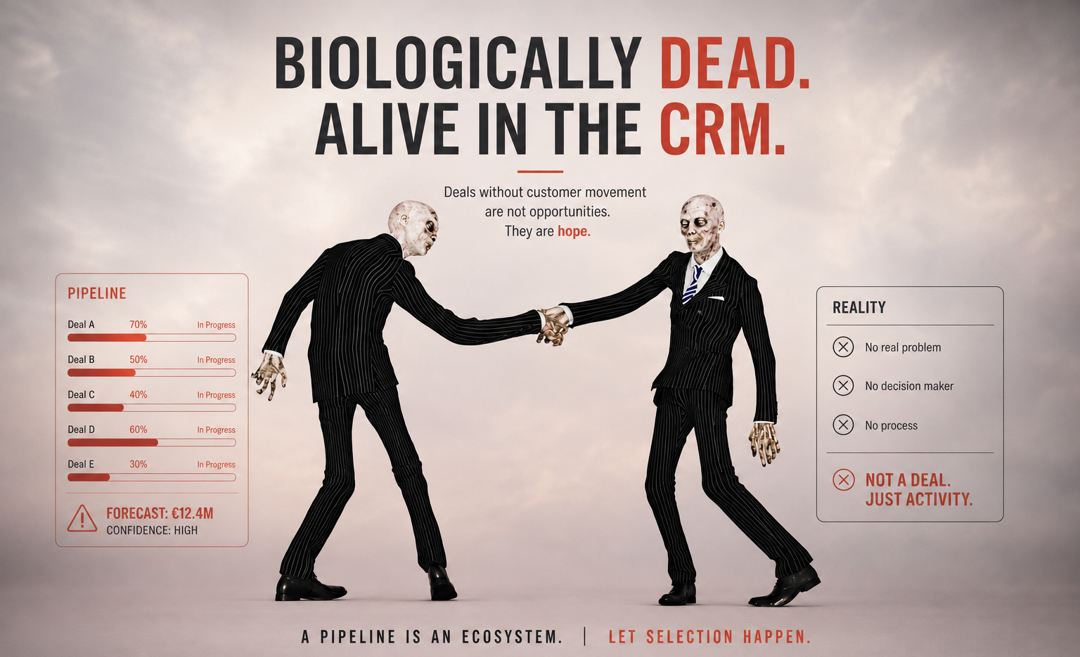
Deals do not die. They are protected.

Close dates get pushed. Probabilities stay unchanged. Internal activity replaces customer-side progress. And no one asks the only question that matters:
What has actually changed at the customer — since the last conversation?

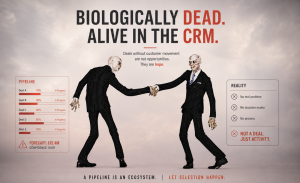
The result is a system that works against its own logic. Biologically dead. Alive in the CRM.
This is not a forecast problem. This is anti-Darwinism — actively practiced, daily, with the best of intentions.

4. Survival of the Fittest: The Best Product Does Not Win.
This is the fallacy almost every sales organization carries with it.
– The best product wins.
– The most compelling demo wins.
– The most complete feature list wins.

Darwin would disagree.

Not the strongest survives — the best adapted. In sales, the best product does not win. The deal that fits the customer wins. Everything else is product thinking.

5. What Darwin Actually Demands.
Selection is being prevented. And that is exactly the problem.

The consequence is simple: selection must be allowed. Not theoretically. Not next quarter.
Now.

Opportunities without customer-side movement die. No resuscitation through internal activity. No pushed close dates as a substitute for missing clarity.

Organizations must stop protecting their own system. Forecasts that do not force decisions. Pipeline reviews that generate comfort instead of clarity. CRM fields that encode hope instead of reflecting reality. All of this is the same pattern: the ecosystem gets distorted. Weak opportunities get protected. And everyone wonders why growth is not happening.

6. The Real Question.
Most organizations ask: How do we get more opportunities into the pipeline?
The wrong question.

Darwin asks: Which opportunities have the right to survive — and which are only being kept alive because dying is uncomfortable?

Growth does not come from more variation. It comes from better selection.

Sales does not fail because of too few opportunities. It fails because of too little selection.
Everything else is hope. Just better worded.


Back ------


Business Reality Review & The Forecast Illusion

Business Reality Review
The Forecast Illusion – and How to Break It

Companies love numbers.
They love dashboards, forecasts, probabilities, funnels, pipelines, and reports.
And yet they keep failing at the exact same point:

The numbers look plausible – but reality does something else.

The Business Reality Review is not another tool, not a new meeting, and not a methodological upgrade.

It is a leadership and steering system that asks an uncomfortable question:
Is your revenue planning based on real causality – or on hope, activity, and well-told stories?

Anyone who answers that question honestly realizes very quickly:
Most forecasts are not steering instruments.
They are sedatives.

What this system deliberately is not

The Business Reality Review is not a sales meeting where deals are retold.
It is not a forecast ritual designed to produce numbers that simulate certainty.
It is not a coaching format, not a feedback circle, and not a space for opinions.

It is a steering instrument.
And if nothing is decided, changed, or stopped after the meeting, it was not a Business Reality Review – it was a waste of time.

The real problem nobody wants to name

In most organizations, there are more numbers than clarity:

  • Revenue targets.
  • Forecasts.
  • Pipelines.
  • Probabilities.
  • CRM reports.

And yet the same things keep happening:

  • Forecasts regularly miss the mark.
  • Meetings revolve around individual cases.
  • Activity is confused with progress.
  • Numbers calm people down – but they do not lead.

The core mistake is surprisingly simple and deeply structural:

  • Numbers are reported, but not interpreted.
  • And certainly not placed into a causal context.
  • The Business Reality Review starts exactly here – and cuts away everything else.

The simple, hard core idea

Revenue only happens when two conditions are fulfilled at the same time.

First:
There is enough potential volume.

Second:
The organization is capable of actually closing that volume.

Not by gut feel.
Not by storytelling.
Not by explanation.
But measurably.

These two realities are strictly separated in the Business Reality Review.
Not blended, not softened, not interpreted as “holistic.”

There are exactly two metrics:

  • Volume Indicator.
  • Execution Indicator.

Everything else is noise.

Volume Indicator – the brutal volume question

The Volume Indicator answers one single question:
Is there enough pipeline at all to reach the revenue target?

It does not measure how well selling is done.
It does not measure competence, engagement, or effort.

It measures only one thing:
Is the sheer amount of opportunity sufficient – yes or no?

A strong Volume Indicator is not success.
It is merely the absence of a structural deficiency.

If this number is weak, you do not have a sales problem.
You have a go-to-market problem.

Execution Indicator – the uncomfortable truth

The Execution Indicator asks the question most organizations avoid:
How realistic is it that this pipeline will actually turn into revenue?

It does not measure activity.
It does not measure conversation quality.
It does not measure hope.

It measures closing capability.

Every opportunity has a value and a probability.
The Execution Indicator is based on the weighted forecast – and therefore on the honesty of those probabilities.

Weak execution does not mean people do not work hard.

It means deals are qualified poorly, decisions come too late, or selling becomes political.

Why only both indicators together create reality

The real value of the system does not sit in the individual metrics, but in their combination.

High Volume Indicator, low Execution Indicator:
Many opportunities, low closing probability.
A lot of work, little impact.
Typical for weak qualification, early-stage deals, and missing decision power on the customer side.

Low Volume Indicator, high Execution Indicator:
Good deals, clean closes – but too little pipeline.
Not a sales problem, but an acquisition, positioning, or capacity problem.

Both indicators weak:
Not an operational issue.
A leadership and go-to-market failure.

Both indicators strong:
Sufficient volume.
Realistic execution.
That is not luck – that is steering.

What actually happens in the Business Reality Review

The system runs weekly or monthly.
No drama. No show. No deal theater.

Each accountable owner simply reports:
On Track or Not On Track – based on volume and execution.

If something is Not On Track, an issue is named.
Not discussed. Not explained. Named.

All issues are collected, prioritized, and solved one by one.
Decisions lead to clear actions.

Individual deals matter only if they reveal a structural problem.
Not because they sound exciting.

The real benefit

The Business Reality Review does not improve numbers.
It makes them more honest.

And honest numbers are the prerequisite for leadership.

For decisions.
For focus.
For accountability.
For fewer surprises.
For fewer political forecasts.

Or put differently:
This system does not tell you how to sell.
It shows you where your reality does not match your story.

That is exactly why it works!

Back ------


en_US