
Darwin's logic is brutally simple.
Variation. Selection. Adaptation.
Not the strongest survives. The best adapted.
That applies to species. To markets. And to every pipeline.
1. Variation: The Pipeline Is Not a Queue. It Is an Ecosystem.
Every sales opportunity is its own organism.
Different urgency at the customer. Different power dynamics in the account.
Different political dynamics. Different decision logic.
Stages, criteria, forecast logic — these must be standardized. That is architecture.
What must not be standardized: the strategy. The attention. The resources.
A deal at 30% is not a state — it is a situation. And every situation is different:
different competition, different political dynamic, different decision-maker, different time pressure.
Anyone who treats all deals at 30% the same is not managing.
They are running a monoculture. And monocultures collapse — not slowly, but suddenly.
Anyone who treats all deals the same does not lose oversight. They lose control.
2. Selection: The Environment Decides. Not the CRM.
In nature, it is not the organism that decides whether it survives. The environment decides. In sales, the environment is the customer.
Not the forecast. Not the pipeline review. Not the internally set close date. It is the customer.
And the customer's environment asks exactly three questions:
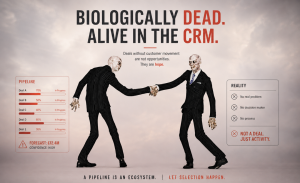
– Is there a real problem — or only interest?
– Is there someone with decision authority — or only with an opinion?
– Is there a real buying process — or only conversations?
Anyone who cannot answer these questions does not have a deal. Only hope.
3. Extinction: What Actually Dies — and What Is Kept Artificially Alive.
This is the uncomfortable part.
In nature, most variants die. That is not a tragedy. That is function. Selection makes the system strong because it removes the weak. In most sales organizations, this does not happen.
Deals do not die. They are protected.
Close dates get pushed. Probabilities stay unchanged. Internal activity replaces customer-side progress. And no one asks the only question that matters:
What has actually changed at the customer — since the last conversation?
The result is a system that works against its own logic. Biologically dead. Alive in the CRM.
This is not a forecast problem. This is anti-Darwinism — actively practiced, daily, with the best of intentions.
4. Survival of the Fittest: The Best Product Does Not Win.
This is the fallacy almost every sales organization carries with it.
– The best product wins.
– The most compelling demo wins.
– The most complete feature list wins.
Darwin would disagree.
Not the strongest survives — the best adapted. In sales, the best product does not win. The deal that fits the customer wins. Everything else is product thinking.
5. What Darwin Actually Demands.
Selection is being prevented. And that is exactly the problem.
The consequence is simple: selection must be allowed. Not theoretically. Not next quarter.
Now.
Opportunities without customer-side movement die. No resuscitation through internal activity. No pushed close dates as a substitute for missing clarity.
Organizations must stop protecting their own system. Forecasts that do not force decisions. Pipeline reviews that generate comfort instead of clarity. CRM fields that encode hope instead of reflecting reality. All of this is the same pattern: the ecosystem gets distorted. Weak opportunities get protected. And everyone wonders why growth is not happening.
6. The Real Question.
Most organizations ask: How do we get more opportunities into the pipeline?
The wrong question.
Darwin asks: Which opportunities have the right to survive — and which are only being kept alive because dying is uncomfortable?
Growth does not come from more variation. It comes from better selection.
Sales does not fail because of too few opportunities. It fails because of too little selection.
Everything else is hope. Just better worded.

